News

After conducting her experiments at Biogem, Dr. Pratiksha Kavade from India defended her PhD thesis in Translational Medicine from the University of Campania "L. Vanvitelli," concerning a study on the mechanisms that regulate embryonic development. Her thesis is titled "The Role of CBX2 in Zebrafish Development: Crosstalk Between Polycomb Repression, WNT/β-Catenin, and Retinoic Acid Signaling."

Her research focused on the role of a protein called CBX2, which helps control the activation and deactivation of genes during early life. This type of regulation is essential for ensuring that cells develop properly and acquire their specific functions.

The work, conducted under the supervision of Professor Lucia Altucci and Professor Vincenzo Carafa, heads of Biogem's Laboratory of Medical Epigenetics, and in collaboration with the group led by Professor Concetta Ambrosino, head of Biogem's Laboratory of Genetically Modified Animal and Cellular Models, used the zebrafish, a small fish widely used in biological research to understand human developmental processes, as a model.

The results show that the absence of the CBX2 protein significantly impairs embryonic development, causing alterations in the organism's shape, increased cell death, and imbalances in important cell-cell communication systems. These systems are essential for coordinating growth and tissue formation.

Overall, the study highlights the central role of CBX2 in biological development and opens new perspectives for better understanding certain developmental diseases and, potentially, even certain types of cancer.
An international team of researchers has identified a new biological mechanism that could contribute to the development of more effective therapies against acute myeloid leukemia (AML), an aggressive form of blood cancer.

The study includes as key contributors Professor Lucia Altucci and Professor Vincenzo Carafa, respectively head and co-head of the Medical Epigenetics Laboratory at Biogem, along with Professor Carmela Dell'Aversana of LUM University. The results were published in Cell Death & Disease.

The research identified a new epigenetic regulation mechanism, namely a new way in which tumor cells regulate a gene called BCLAF1. Specifically, this gene can produce two different versions: one, called the full-length isomorph, which promotes tumor growth, and one, called the short-length isomorph, which helps block it. Understanding how this process is controlled is crucial to developing new treatments.

Scientists have also discovered a regulatory system involving specific proteins and cellular mechanisms capable of influencing gene behavior through modifications to the DNA structure. This system appears to play a key role in the development of acute myeloid leukemia.

A particularly promising result involves the use of drugs already under investigation, known as "epidrugs," which could restore the balance between the two versions of the gene. This approach paves the way for new, more targeted therapies, with the potential to fight the disease more effectively.

The study is the result of an international collaboration involving several research institutions in Europe: in addition to Biogem, the Vanvitelli University of Naples, LUM University, VUMC of Amsterdam, Lund University, Roma Tre University, Sapienza University of Rome, the University of Salerno, AORN Cardarelli, and IEOMI-CNR.

This discovery is an important step toward a better understanding of acute myeloid leukemia and offers new hope for the development of innovative treatments in the future.

For more information: https://www.nature.com/articles/s41419-026-08594-4


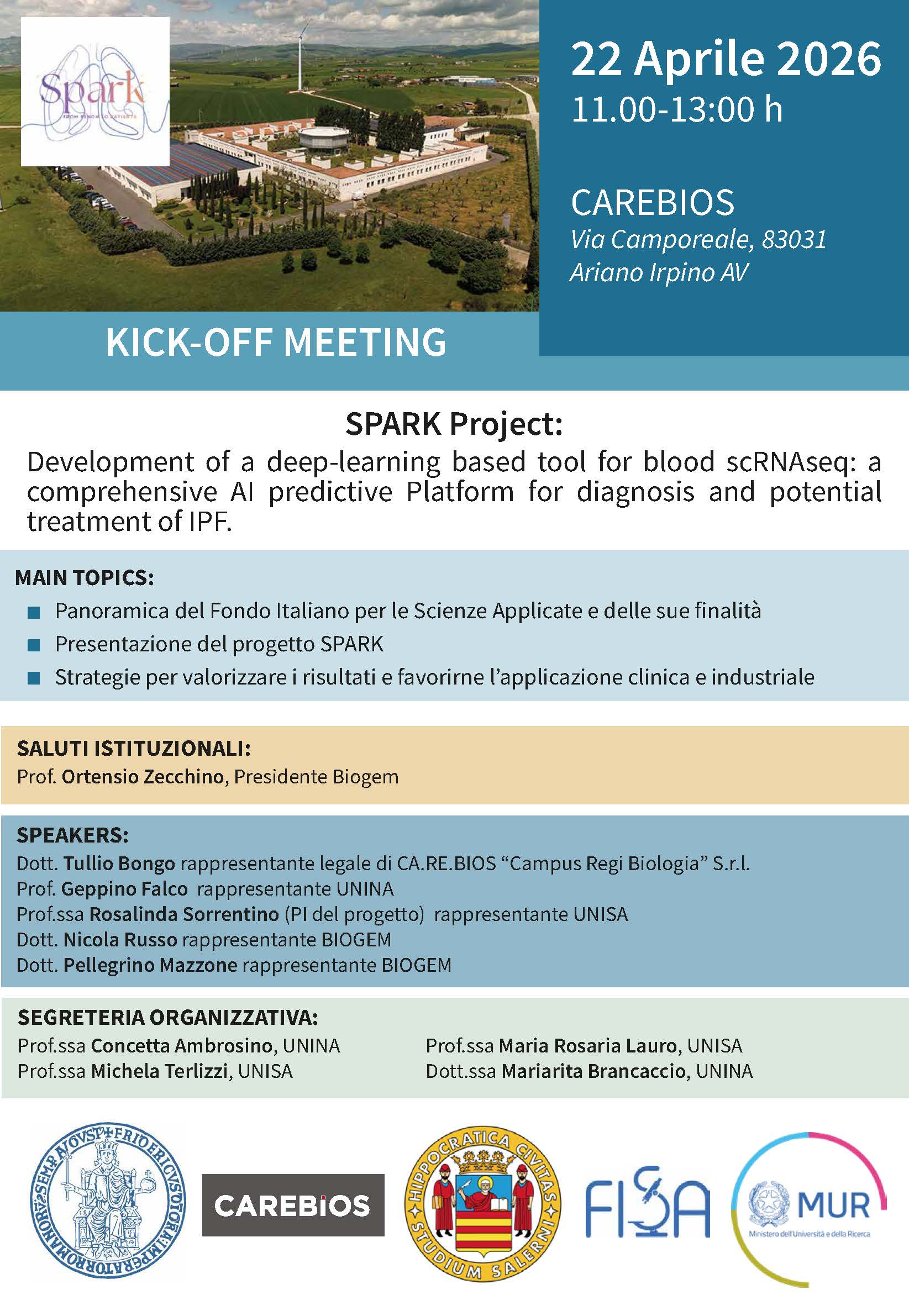
A new research project entitled "Development of a deep-learning based tool for blood scRNAseq: a comprehensive AI predictive Platform for diagnosis and potential treatment of IPF" (acronym: SPARK) will be launched on Wednesday, April 22, at 11:00 a.m. in the "Emmanuele F.M. Emanuele" Aula Magna at Biogem in Ariano Irpino (AV). The project is funded by the Italian Ministry of University and Research as part of the Call for Project Proposals under the Italian Fund for Applied Sciences contained in Decree No. 1075 of July 18, 2024 (FISA-2024).

Carebios srl, a subsidiary of Biogem, is the company where the research activities will be carried out. Professor Rosalinda Sorrentino of the University of Salerno is the principal investigator of the SPARK project, which also involves the University of Naples Federico II.

Idiopathic pulmonary fibrosis (IPF) is a serious lung disease in which tissue hardens and becomes progressively damaged, compromising breathing and the patients quality of life. Currently available drugs slow the progression of the disease, but they are not sufficient to completely stop it, also because IPF is often diagnosed too late. Furthermore, rapid and precise diagnostic tools that allow for timely intervention and effective monitoring of therapies are lacking.

The SPARK project aims to fill these gaps by developing easy-to-use software based on advanced blood cell analysis to identify early signs of the disease and to better understand its causal mechanisms.

To this end, the five-year project will combine various approaches, including the analysis of lifestyle, clinical data, and diagnostic images (X-rays and CT scans) of IPF patients, the development of an AI-based platform, and the use of experimental models, both cellular and animal.

Thus, the project aims to improve early diagnosis, disease monitoring, and the development of new, more effective treatments.

Dr. Lucia Pasquale, from the Biogem Laboratory of Molecular Oncology and Precision Medicine, directed by Professor Michele Caraglia, will present the latest results of her research on prognostic and predictive biomarkers for head and neck carcinoma on Tuesday, April 14, at 12:00 p.m. in Biogem's "Emmanuele F.M. Emanuele" Aula Magna. Her work focuses specifically on the molecular characterization of laryngeal carcinoma to improve the ability to predict tumor development.

To know more about Biogem research in oncology: https://www.biogem.it/index.php/en/biomedical-research/oncology-area

Supplier Register

Login