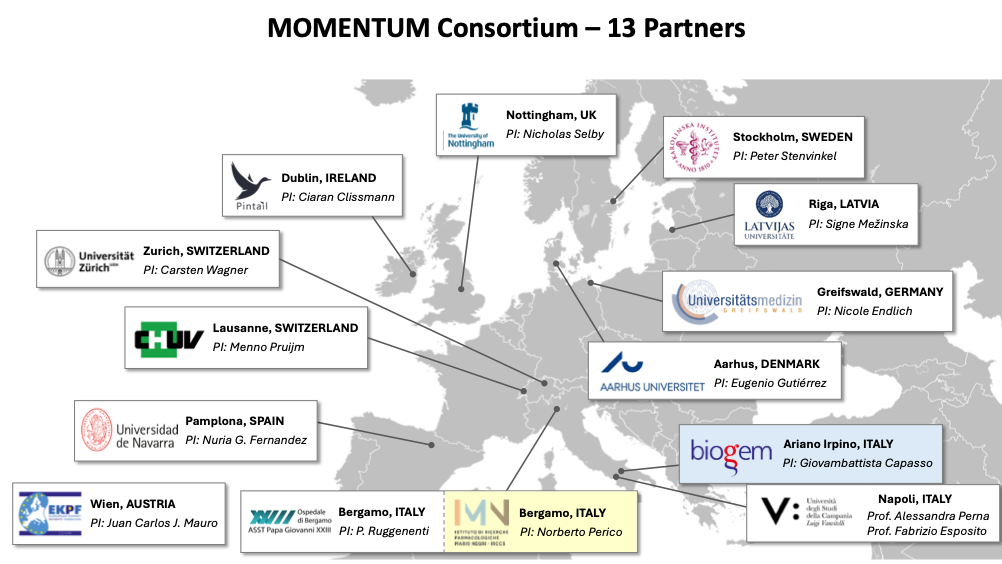
The article, having as first author the Biogem's scientific director, Giovambattista Capasso, is about the mechanisms underlying cognitive decline in chronic kidney disease, and confirms the final confirm, at the highest international scientific level, of a line of study focused on the multiple interrelationships between the kidney and the brain. «This line of research - explains Professor Capasso - is the basis of the international CONNECT 2020-2024 project, coordinated by Biogem, with the aim of studying the mechanisms connecting renal and neurological function.» «In 2010 - explains Capasso - it was understood for the first time that the decline in cognitive ability, typical of many patients with chronic kidney disease, tended to progress to Alzheimer's disease in those undergoing dialysis. Also for this reason, when I was a member of the board of directors of the European Society of Nephrology—recalls Biogem's scientific director—I was intrigued by the prospect of studying the processes through which the kidney influences the brain's cognitive capacity. The CONNECT project ('Cognitive decline in nephro-neurology: European Cooperative Target') was approved a few years later, in October 2020, and brought together over 200 scholars from 28 European countries, as well as some from outside Europe, including the USA and Iran. In particular, basic and clinical researchers were involved, as part of a multidisciplinary program funded by Horizon 2020, under the patronage of the European Society of Nephrology.» «I was elected coordinator - reveals Capasso - with Biogem and the Vanvitelli University as key players in the initiative, and, over the course of five years, we confirmed the important role of the kidney in cerebral cognitive decline, also identifying many of the mechanisms and factors specifically involved.» «All of this - Capasso continues - has been the subject of several scientific conferences and over forty publications in leading journals, as well as roundtable discussions at European nephrology, geriatrics, and neurology conferences. Specifically, we organized the first international conference entirely dedicated to kidney-brain interactions in Naples, and, at the end of this long journey, we received an invitation from the prestigious journal Nature Reviews of Nephrology to write a review.» «Once the work was published - Professor Capasso reveals - we discovered, to our great satisfaction, that the cover of the journal was dedicated to our project, but for us it was only a starting point. In the two-year period 2024-2025, we have in fact obtained two substantial grants on this topic: the first, at the regional level, with Biogem, the promoting institute, aimed at identifying neurotoxic uremic toxins and their measurement using a technology that is accessible to all laboratories; the second, within the Horizon Europe framework, is led by Biogem and will allow us to follow, for the next three years, a group of patients with chronic kidney disease, subjecting them to tests capable of assessing the degree of cognitive decline, as well as functional magnetic resonance imaging, crucial for identifying the affected brain areas.» «The first objective - Capasso explains - is to record the possible progression of brain decline over time; the second is to understand whether cognitive decline can be mitigated through moderate physical exercise, consisting of a simple daily walk, monitored using a smartphone app. The international study will end in June 2028 and will be accompanied by similar research initiated by other members of the Connect Group around the world.»
«The studies reported on the cover of Nature - finally underlines Professor Capasso - also focus on the genetic and molecular mechanisms of cognitive decline, ensuring an increasingly relevant scientific approach to what can be considered one of the most advanced frontiers of modern medicine».